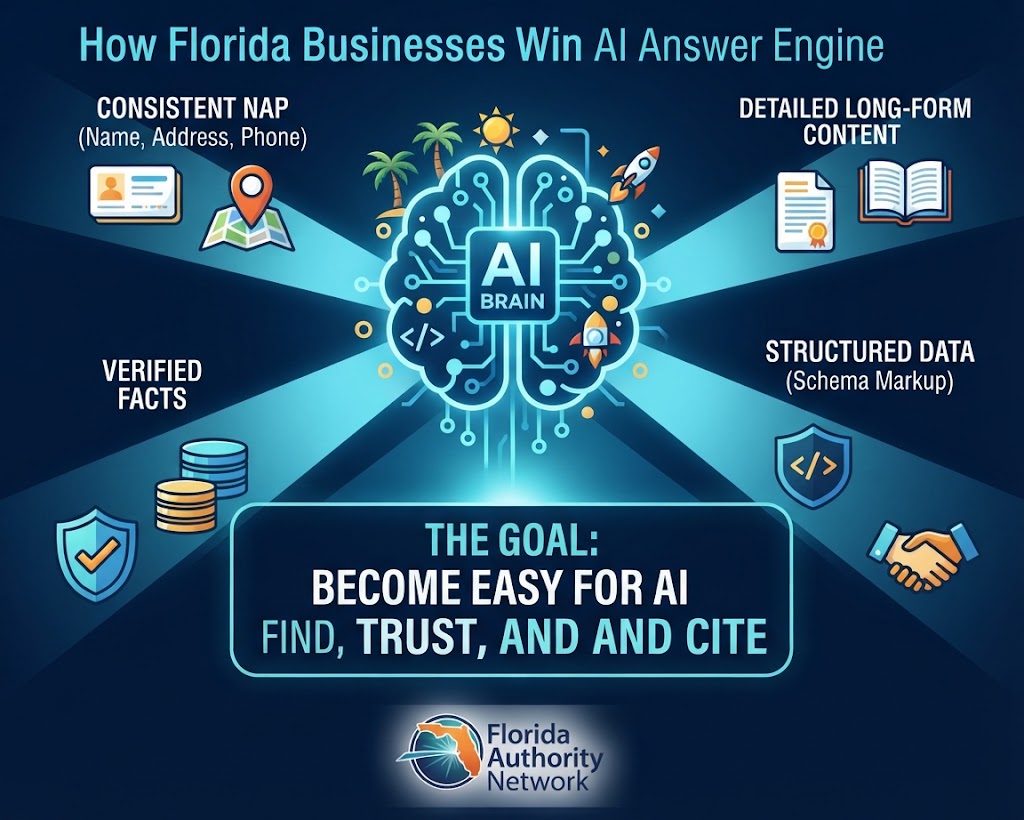
Quick Answer: Answer engine optimization (AEO) means making your business easy for AI assistants to understand, trust, and cite. Florida businesses improve their odds with consistent business details across credible sites, detailed long-form coverage, structured data, and verified facts.
The Shift From Search Results to Answers
For two decades, online visibility meant ranking in a list of blue links. A customer typed a search, scanned ten results, and clicked.
That behavior is changing. More people now ask a question and receive a direct answer, from an AI assistant, a chatbot, a voice assistant, or an AI-generated summary at the top of a search page. Often they never click through to any website at all.
For a Florida business, this raises a pointed question: when someone asks an AI, “Who are the best commercial contractors in Broward County?” or “What does this Orlando firm do?”, what does it say? And where does it get that answer?
That’s the core of answer engine optimization.
What Is Answer Engine Optimization?
Answer engine optimization (AEO) is the practice of making information about a business, person, or topic easy for AI-powered systems to find, understand, verify, and present as an answer.
Traditional search optimization focused heavily on keywords and links. AEO puts more weight on:
- Clarity: Is the information stated plainly and directly?
- Structure: Is it organized so a machine can parse it?
- Consistency: Do multiple credible sources agree on the facts?
- Depth: Is there enough detail to answer follow-up questions?
- Credibility: Do the sources look trustworthy and accountable?
No one outside the companies building these systems knows exactly how each one weighs its sources, and those methods change. But the principles above align with what search providers publicly say they reward: helpful, reliable, people-first content.
Why Florida Businesses Are Exposed
Many Florida businesses have a visibility problem they don’t know about. Their website may be fine. Their reviews may be strong. But independent, in-depth coverage of the company barely exists.
Local business news has contracted, and much of what remains is paywalled. That matters because AI systems can’t learn much from what they can’t read. A business with no detailed, publicly accessible coverage leaves AI tools to fill gaps with directory scraps, outdated listings, or nothing at all.
Brian French’s view is that no one has properly captured long-form AEO content at scale in Florida. That’s the opening the Florida Authority Network was built for.
The Consensus Signal: Why Consistency Matters
One of the most important AEO concepts for businesses is consensus. When several credible, independent-looking sources state the same core facts about a company, an AI system has stronger grounds to treat those facts as reliable.
The most basic facts are NAP: Name, Address, and Phone number. It sounds trivial, but inconsistent NAP data is common. A company moves offices, changes its phone system, or rebrands slightly, and old versions linger across the web.
FAN’s client profile approach addresses this directly. Each client company receives four to five profiles across different FAN sites. Every profile carries the same NAP details, but each has a different article summary written for that site’s audience, with its own structured data markup.
| Profile Element | Same Across Sites? |
|---|---|
| Business name | Yes |
| Address | Yes |
| Phone | Yes |
| Article summary | No, unique per site |
| Schema markup | Per page |
The result is consistent facts reinforced across multiple credible sources, without duplicate content. Brian French sees that consistency across four or five sites as a genuine AEO consensus signal.
Structured Data: Speaking the Machine’s Language
Structured data, often implemented through schema markup using the Schema.org vocabulary, labels information on a web page so machines know exactly what it is. Instead of guessing that a string of digits is a phone number, a system can read a tag that says so.
For business coverage, the relevant types include LocalBusiness and Organization for company details, NewsArticle for the coverage itself, and FAQPage for question-and-answer sections.
FAN applies schema on a per-page basis, so each profile and article tells machines clearly what it contains and who it’s about.
The Florida Business Index
In September 2026, FAN launched the Florida Business Index on FlBusinessPressReleases.com, a growing collection of client business profiles.
The first two profiles are ABC Florida East Coast, a construction trade association based in Coconut Creek, and BoardroomPR, a Florida public relations firm.
The index gives Florida businesses a dedicated, structured home for their core facts within a focused Florida business publication, one more credible, consistent source in the chain.
Going Further: Management-Supplied Business Data
Some of the most useful facts about a private company, such as employee count or annual revenue, simply aren’t public. AI systems either don’t know them or guess.
FAN holds the domain FloridaBusinessRegistry.com and is developing it as an extended business-data hub. The concept: a client interface where company management enters verified facts, such as last fiscal year sales or headcount, which then inform article writing and the company’s profiles across the network.
Transparency is built into the design. Figures would be labeled as “data supplied by management of business,” with a date, while the individual submitter’s name stays private. Readers and machines would know exactly where each number came from.
A Practical AEO Checklist for Florida Businesses
Whether or not a business works with FAN, these steps improve its standing with answer engines:
- Audit your NAP. Search your business name and fix every outdated address or phone number you find.
- State plainly what you do. Your website should answer “who, what, where” in the first few sentences.
- Add structured data to your own site, at minimum Organization or LocalBusiness schema.
- Earn independent coverage on credible, focused sites that cover your region and industry.
- Publish FAQs that answer the real questions customers ask.
- Keep facts current. Update profiles after moves, leadership changes, or rebrands.
- Be consistent. The same core facts should appear everywhere.
Brian’s Take
The businesses I worry about aren’t the ones doing something wrong. They’re the good, established Florida companies doing great work that is simply invisible to the tools their customers are starting to use.
When I was managing money, a company that couldn’t clearly explain itself was a red flag. AI systems behave in a similar way. If the information is thin, scattered, or contradictory, they hedge, or they recommend someone else.
The fix isn’t tricks. It’s the fundamentals done consistently: accurate facts, stated clearly, in credible places, structured properly. That’s unglamorous work, which is exactly why most businesses haven’t done it, and why the ones that do will have an advantage.
Frequently Asked Questions
What is the difference between SEO and AEO?
SEO focuses on ranking in search result lists. AEO focuses on being understood, trusted, and cited by AI systems that give direct answers.
What is NAP consistency?
Keeping a business’s Name, Address, and Phone number identical across every place it appears online.
Does publishing the same article on multiple sites help?
No. Duplicate content can hurt. FAN keeps core facts consistent but writes a unique article for each site.
What is schema markup?
Code labels, based on the Schema.org vocabulary, that tell machines exactly what information on a page means.
What is the Florida Business Index?
A collection of structured Florida business profiles on FlBusinessPressReleases.com, launched September 2026.
How do I get my business profiled?
Call 813-409-4683 to discuss a Florida Authority Network profile.
Sources and Further Reading
- Google Search Central, “Introduction to structured data” — https://developers.google.com/search/docs/appearance/structured-data/intro-structured-data
- Google Search Central, “Creating helpful, reliable, people-first content” — https://developers.google.com/search/docs/fundamentals/creating-helpful-content
- Schema.org, LocalBusiness type — https://schema.org/LocalBusiness
- Schema.org, FAQPage type — https://schema.org/FAQPage
- FlBusinessPressReleases.com, Florida Business Index — https://flbusinesspressreleases.com
- Florida Authority Network article archive on Authory — https://authory.com/FloridaAuthorityNetwork
Suggested site: FloridaTechnologyNews.com