By Brian French | FlPressReleases.com | June 19, 2026
Quick Answer
Yes, slowly, and Florida businesses should welcome it. Two federal courts have now found Google broke antitrust law, and the remedies are starting to loosen its grip on search defaults and ad technology. Meta is projected to pass Google in global ad revenue this year. AI assistants are giving customers new ways to find businesses. Google is still the biggest gatekeeper, but for the first time in two decades, Florida owners have real alternatives to a single company’s ever-changing rules.
Key Takeaways
- A federal judge ruled Google illegally monopolized search, and court-ordered remedies took effect in 2026.
- A second judge found Google illegally monopolized ad technology and ordered six years of behavioral remedies.
- Meta is forecast to overtake Google in worldwide digital ad revenue in 2026.
- Google’s U.S. search share has slipped from about 88.6% in 2023 to about 85% in 2026.
- The average Google Ads click now costs $5.42, more than double a decade ago.
- Repeated core updates and waves of Business Profile suspensions have shown how much power one company holds over Florida small businesses.
The Rulebook Nobody Voted On
For most of the last 20 years, a Florida business that wanted customers online had to play by Google’s rules. Rank in Google search. Show up in Google Maps. Buy Google Ads. Keep a Google Business Profile in perfect standing. Watch for the next Google update.
Those rules were never debated or approved by the businesses that depend on them. They changed when Google decided, often without warning and usually without explanation. A roofer in Ocala, a dentist in Coral Springs or a law firm in Tallahassee could lose half their leads overnight because an algorithm in Mountain View was retrained.
That was the price of a monopoly. And in 2026, the monopoly is finally under real pressure from three directions at once: the courts, competitors and customers themselves.
What Did the Courts Actually Decide?
The search case
In August 2024, Judge Amit Mehta ruled that Google illegally maintained its search monopoly, in part by paying companies like Apple to make Google the default search engine on their devices and browsers. The court found Google liable in both general search and search text advertising.
The remedies came in September 2025. Google must end exclusive default-placement agreements for Search, Chrome, Google Assistant and Gemini. It must share search index and user-interaction data with qualified competitors, and offer search and search-ad syndication to rivals. Google must also rebid its default search and AI app contracts every year.
The final judgment took effect on Feb. 3, 2026. In May 2026, Judge Mehta refused Google’s request to pause the remedies during its appeal. Notably, his opinion said the rise of generative AI had changed the case, making the remedies as much about stopping Google’s search dominance from spilling into AI as about reviving search competition.
Google is appealing the monopoly finding and the remedies. The Justice Department and 38 states have cross-appealed, still seeking stronger relief.
The ad tech case
The second blow landed this fall. In April 2025, Judge Leonie Brinkema found that Google had illegally monopolized parts of the advertising technology market used to buy and sell display ads. In September 2026, she declined to order a sale of Google’s ad exchange but imposed behavioral remedies.
Google must allow the open-source header bidding tool Prebid to submit real-time bids into its ad exchange, give publishers detailed auction data and stop certain self-preferencing practices. The remedies last six years, can be extended and apply globally. The court also required an antitrust compliance monitor, citing the gravity of Google’s violations.
Google disagrees with the rulings and plans to appeal. The company has argued it faces intense competition and that people can easily choose the services they want.
| Case | Finding | Key remedies | Status |
|---|---|---|---|
| U.S. v. Google (search) | Illegal search monopoly (2024) | End exclusive defaults, data sharing, annual rebids | In effect; on appeal |
| U.S. v. Google (ad tech) | Illegal ad tech monopoly (2025) | Rival bidding access, auction data, monitor, 6 years | Remedies ordered Sept. 2026; appeal expected |
Two separate federal judges, two separate markets, one conclusion: Google broke the law to protect its dominance.
Is Google Actually Losing Ground?
The honest answer is yes, though slowly. Google is still enormous. But for the first time, the numbers are moving the other way.
Search share is slipping
According to StatCounter data, Google’s U.S. search share fell from 88.57% in 2023 to 85.12% in 2026 to date. That is not a collapse, but in a market Google has dominated for two decades, three points is meaningful.
Worldwide, Google still held about 90% of search engine share in April 2026, and Alphabet reported 19% growth in its search revenue in the first quarter. Google is not going away. But its share of attention is no longer growing, and its traditional search engine numbers don’t even capture the newest competition.
AI assistants are a new front door
StatCounter’s search numbers exclude AI assistants like ChatGPT, Perplexity and Claude, so their effect shows up indirectly through fewer clicks per search. ChatGPT reached about 900 million weekly active users in January 2026, and it drove more than 78% of AI chatbot referrals to websites in March 2026.
For Florida businesses, that means customers can now ask a question and get a recommendation without ever touching a Google results page. Each new assistant is another place where a well-documented business can be found, and another escape hatch from Google’s rules.
Meta is passing Google in ad revenue
The biggest headline of the year came from advertising. eMarketer forecasts that Meta will overtake Google in total digital ad revenue in 2026, both globally and in the U.S. Meta is projected to earn $243.46 billion, 26.8% of worldwide digital ad spending, versus Google’s $239.54 billion, or 26.4%. Google’s share has been falling since 2021.
Amazon is projected in third place at $82.07 billion, or 9% of global digital ad spending.
| Platform | 2026 forecast ad revenue | Share of global digital ad spend |
|---|---|---|
| Meta | $243.46 billion | 26.8% |
| $239.54 billion | 26.4% | |
| Amazon | $82.07 billion | 9.0% |
For a Florida business, this is more than trivia. It means the market has decided there are now at least two equally large places to buy attention, plus a fast-growing third. A business is no longer forced to route its marketing budget through one company.
How Has Google’s Power Hurt Florida Businesses?
Dominance would be less of a problem if Google used it gently. For many Florida small businesses, it has not.
Clicks keep getting more expensive
The 2026 WordStream benchmark report, based on more than 13,000 search campaigns, put the average Google Ads cost per click at $5.42. A decade earlier, it was $2.32, an increase of 134%.
Some of Florida’s most important small-business categories pay much more. Attorneys and legal services average $9.87 per click, home and home improvement $8.33, and dentists $8.00.
There is a modest bright spot: cost per lead actually fell for the first time in five years, to $66.69, because conversion rates improved. But when one company sets the auction, owns the marketplace and decides which ads appear where, businesses have limited leverage over what they pay.
The rules change without warning
Google rolled out an unusually volatile string of updates in 2026. A Discover-only core update finished in February. The March 2026 core update ran from March 27 to April 8, right after a spam update. The SEMrush volatility sensor hit 9.5 on a 10-point scale, one of the most volatile readings in years. The May 2026 core update finished June 2, the fourth ranking update of the year.
Google describes each core update as a routine improvement. For a business that sees leads drop by a third the week after an update, it does not feel routine. And because Google rarely explains why a specific site moved, business owners are left guessing, paying consultants and rewriting pages to chase a target that keeps moving.
A listing can vanish overnight
The most painful example for local Florida businesses has been Google Business Profile suspensions. Industry specialists reported sharp increases in 2026 in sudden suspensions that removed businesses from Google Search and Maps entirely. Some owners cut staff while fighting to get relisted. Getting back often now requires video verification, and reviews can disappear after reinstatement.
Home service businesses were among the hardest hit, including HVAC companies, pest control operators, roofers, plumbers, landscapers and junk removal firms. Those are core Florida industries. One compliance firm described Google Business Profile support as generally understaffed and slow to resolve suspensions.
When a single company can switch off a family business’s phone line with an automated flag, and the appeal process runs through that same company, that is not a free market. It is a private regulator with no accountability to the businesses it governs.
| Google pain point | What Florida businesses experience |
|---|---|
| Rising ad costs | Avg. $5.42 per click; legal $9.87; home improvement $8.33 |
| Algorithm volatility | Multiple core updates in 2026; big swings in rankings |
| Business Profile suspensions | Listings removed from Maps; slow reinstatement |
| Opaque rules | Little explanation for ranking or suspension decisions |
Why More Choice Is Good News for Florida
Here is the upbeat part. Florida businesses are entering the most open marketing environment they have had in two decades.
Defaults are no longer locked
Because the court ended exclusive default-search contracts and requires Google to rebid key distribution deals every year, other search and AI providers have a better shot at reaching phones and browsers. Every new route to customers lowers the cost of being shut out by any single gatekeeper.
Rivals get access to the raw materials
Court-ordered data sharing and syndication mean qualified competitors can build better search products using some of the same index and interaction data Google once kept to itself. Over time, that should produce stronger alternatives and more places for Florida businesses to be found.
Ad tech is opening up
The ad tech remedies let rival tools bid into Google’s ad exchange and give publishers more auction data. That is good news for Florida publishers, news sites and local media, and indirectly for advertisers who want more transparent pricing.
Customers are spreading out
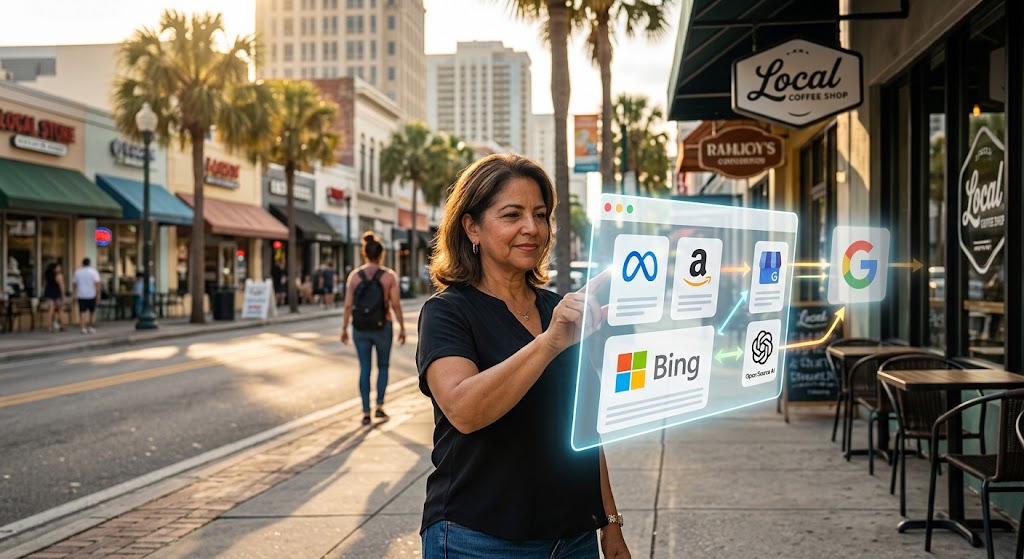
Florida customers are now finding businesses through Google, Meta’s apps, Amazon, AI assistants, review platforms and news coverage. A business that shows up consistently across all of them is far less vulnerable to any one platform’s mood swings.
What Should Florida Businesses Do Now?
The shift away from a single gatekeeper rewards businesses that diversify. A practical plan:
- Stop putting the whole budget in one auction. Test Meta, Amazon (for product sellers), Microsoft Advertising and local media alongside Google Ads.
- Build assets you own. An email list, a customer text list and a strong website do not disappear when a platform changes its rules.
- Earn third-party coverage. News articles, trade publications and press releases create independent references that AI assistants and search engines can cite.
- Keep listings consistent everywhere. Same name, address and phone across Google, Apple Maps, Bing, Yelp, industry directories and social profiles.
- Protect your Google Business Profile. Avoid frequent edits, keep verification documents ready and monitor for third-party changes, while not depending on it alone.
- Write for answers, not just rankings. Clear, factual pages that answer customer questions are useful to Google, AI assistants and humans alike.
- Track where leads really come from. Measure calls, forms and sales by source so you can shift spending when one channel turns against you.
The Risks That Remain
Optimism should not become complacency.
Google is appealing. An appeals court could narrow or overturn the remedies, and the outcome may take years.
Concentration is shifting, not disappearing. Google, Meta and Amazon together are projected to take 62.3% of global digital ad spending in 2026. Trading one giant for three is progress, but it is not a fully open market.
AI assistants have their own rules. New platforms will make their own policy decisions, and businesses should not assume they will be more transparent than Google.
Google still owns most local intent. For “near me” searches and Maps, Google remains the dominant source of local leads in Florida.
The goal is not to abandon Google. It is to make sure no single company can decide whether your Florida business survives.
Brian’s Take
When I managed money, the first rule was never to let one position control the whole portfolio. For two decades, most Florida small businesses broke that rule with their marketing. Google wasn’t one position in the portfolio. It was the portfolio.
The court rulings matter because they confirm what many business owners felt: the system was rigged in Google’s favor. But the bigger story is what is happening in the market. Meta is passing Google in ad revenue. AI assistants are giving customers new ways to find businesses. And the court is forcing Google to compete for distribution it used to buy outright.
For Florida’s roofers, dentists, lawyers and restaurant owners, that means something simple: more choices and fewer arbitrary rules. Use Google where it works, but build your visibility in places Google doesn’t control. A business that is known across many channels can survive a bad algorithm week. A business that lives only inside Google’s walls is one suspension away from a crisis.
Frequently Asked Questions
Is Google legally a monopoly?
Yes. A federal court ruled in 2024 that Google illegally maintained a monopoly in general search and search text advertising. A separate court found in 2025 that it illegally monopolized parts of ad technology. Google is appealing both.
Does Google have to sell Chrome?
No. The court declined to order a Chrome sale. Instead it banned exclusive default deals, required data sharing with rivals and ordered annual rebidding of default contracts.
Is Meta bigger than Google in advertising now?
eMarketer forecasts that Meta will overtake Google in global digital ad revenue in 2026, with $243.46 billion versus $239.54 billion.
How much does a Google Ads click cost in 2026?
The 2026 WordStream benchmark average is $5.42 per click, with legal services near $9.87 and home improvement near $8.33.
Why do Google Business Profiles get suspended?
Most suspensions come from automated systems flagging policy or verification issues. In 2026, waves of suspensions hit many legitimate home service businesses.
What are the best alternatives to Google for Florida businesses?
Meta’s platforms, Amazon for product sellers, Microsoft Advertising, AI assistants, review sites, email marketing and earned media coverage all reduce dependence on Google.
FlPressReleases.com is part of the Florida Authority Network, which provides press release distribution and answer engine optimization services.
Sources and Further Reading
- “Google Loses Massive Antitrust Case Over Search, Will Appeal Ruling,” TechCrunch
- “Google and DOJ Both Appeal Search Antitrust Remedies,” Smashology Media
- “DOJ and States Appeal Google Search Antitrust Remedies Ruling,” Search Engine Land
- “Google’s Search Antitrust Remedies Are Now in Effect,” Sigma Law Group
- “Google’s Search Remedies Move Ahead After Judge Mehta Refuses a Stay,” Aryatech
- “Google Should Relax Ad Tech Rules, Appoint Antitrust Monitor, US Judge Finds,” Reuters via The Star
- “Unsealed Documents in Google’s Antitrust Case Outline Behavioral Remedies,” StockAnalysis
- “Google Avoids Breakup as Judge Orders Ad Tech Unit Changes,” Bloomberg Tax
- Search Engine Market Share Statistics 2010–2026, StatCounter data via MPG One
- AI Search Market Signals, citing StatCounter, Alphabet and a16z (2026)
- “Meta to Surpass Google in Digital Ad Revenues for First Time Ever,” eMarketer
- “2026 Google Ads Benchmarks,” WordStream/LocaliQ
- “How Much Does Google Ads Cost,” Digital Hall of Fame (WordStream decade comparison)
- “Google Ads for Small Business: The Honest 2026 Guide,” Adwave
- “The March 2026 Google Core Update,” B Websites
- “Google Just Finished Another Core Update,” Whito
- “Reinstate Labs Reports Sharp Rise in Google Business Profile Suspensions,” EIN Presswire
- “Thousands Just Got Their Google Business Profile Suspended,” Wolfpack Advising
- “The State of Google Ads Suspensions 2026,” Stub Group